Astronomy
Tools about the Sun, the Moon, the planets and the night sky, with the astronomy behind every number explained in plain words.
Astronomy at a glance
Tools about the Sun, the Moon, the planets and the stars: when they rise, how far they are, how bright they look and how long light takes to arrive. The astronomy behind each number is explained in plain words.
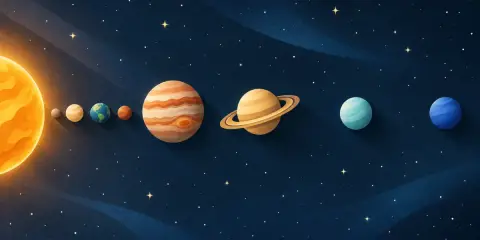
To see what is up tonight, sky tonight places the Moon, Sun and planets above your location, moon phase gives the phase for any date, meteor showers lists peaks with the Moon's brightness, and sunrise and sunset and sun path cover daylight. For scale, the solar system model shrinks the Sun to a size you choose, light travel time and the light-speed delay show distance in seconds, and the astronomical distance converter moves between au, light-years and parsecs. For stars, star magnitude links brightness and distance, blackbody relates colour to temperature and redshift turns a shift into speed and distance. For spaceflight, orbital speed and the rocket equation show what reaching orbit costs, and the gravity sandbox lets you throw planets around. Choosing equipment? The telescope calculator gives magnification and field of view, and star trails the longest sharp exposure. The Drake equation and Kardashev scale are speculative: they show how assumptions change an answer, not what is out there.
Most used in Astronomy
The tools people used most over the last four weeks.
Find a tool
Filter utilities · Tags, What's new
Search results
No utilities match your search yet.
Closest matches
Utilities
- Astronomical distance converter
- Black hole time dilation
- Blackbody radiation calculator
- Cosmic calendar, New
- Day length through the year, New
- Doppler effect calculator
- Drake equation calculator
- Dyson sphere calculator
- Electromagnetic spectrum, Updated
- Gravity sandbox, New
- Interstellar trip time
- Kardashev scale calculator


- Light travel time calculator
- Light-speed delay calculator
- Mars time
- Meteor shower calendar, New
- Moon phase
- Orbital speed calculator
- Planet binding energy
- Redshift calculator, Updated
- Rocket equation calculator
- Sky tonight, New
- Solar system scale model, New
- Star magnitude calculator
- Star trails exposure calculator
- Sun path and balcony sun, New
- Sunrise and sunset
- Telescope calculator
- Time dilation calculator
- Weight on other planets calculator