How fast did it grow each year?
Turn a start value, an end value and the years into one yearly growth rate.
What you enter stays on your device while you use this tool. Opening a shared link sends the settings in its address to HowToolbox to prepare the page.

Return on investment
400%
Gain €400.00 · 71% a year over 3 years
Turn a start value, an end value and the years into one yearly growth rate.
How to use
- Enter the amount you started with and its value at the end.
- Enter the number of years between the two, using decimals for part of a year.
- Read the compound annual growth rate (CAGR), with the total return below it.
Yearly growth needed to multiply an investment
| Years | 2× | 3× | 5× | 10× |
|---|---|---|---|---|
| 3 | 25.99% | 44.22% | 71% | 115.44% |
| 5 | 14.87% | 24.57% | 37.97% | 58.49% |
| 10 | 7.18% | 11.61% | 17.46% | 25.89% |
| 15 | 4.73% | 7.6% | 11.33% | 16.59% |
| 20 | 3.53% | 5.65% | 8.38% | 12.2% |
| 30 | 2.34% | 3.73% | 5.51% | 7.98% |
The CAGR that turns any amount into the shown multiple in that many years.
How it works
The compound annual growth rate is the steady yearly rate that would take an amount from its starting value to its end value. Real returns jump around from year to year; the CAGR smooths them into one rate, which makes investments of different lengths comparable.
The formula is CAGR = (end value ÷ start value)^(1 ÷ years) − 1. It takes the total growth, spreads it over the years as a root and subtracts one. 100 growing to 800 over 15 years is a multiple of 8, and the 15th root of 8 is about 1.149, so the CAGR is about 14.9 % a year.
The CAGR says nothing about what happened in between: two investments with the same start, end and time have the same CAGR even if one fell by half along the way. It also assumes nothing was added or taken out during the period.
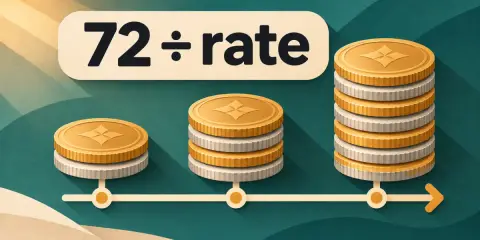
A handy check: at a CAGR of 7 % a year, money doubles in about 10 years, because 72 divided by 7 is roughly 10.
Worked example
What is the CAGR of 100 growing to 800 in 15 years?
- Total growth: 800 ÷ 100 = 8.
- Take the 15th root: 8^0.0667 = 1.1487.
- Subtract one and write it as a percentage.
The CAGR is 14.87% a year.
Method
No outside data is used: the result is worked out directly from the formula ROI = (F − I) / I, explained under How it works.
Frequently asked questions
How is CAGR calculated?
Divide the end value by the start value, raise the result to the power of one divided by the number of years, and subtract one. 100 → 800 over 15 years gives 14.9% a year.
Can I use CAGR for sales or users, not just money?
Yes. Any quantity measured at a start and an end works. Ignore the currency sign on the gain.
What does CAGR stand for?
Compound annual growth rate: the constant yearly growth rate that links a start value and an end value over a number of years.
Why is the CAGR lower than the average of the yearly returns?
Because of compounding. Years of loss weigh more than years of gain of the same size, so an arithmetic average of yearly returns overstates the growth you actually got.