How do you write a palindrome of your own?
Type the first half, get the second half mirrored, break it into words and see every letter that doesn't match.
What you enter stays on your device while you use this tool. Opening a shared link sends the settings in its address to HowToolbox to prepare the page.
Your palindrome
Never odd or even.
Reads the same both ways: 14 letters.
Letter ladder
- Match
Start from an example
Letter rules
Type the first half, get the second half mirrored, break it into words and see every letter that doesn't match.
How to use
- Type the start of your sentence in Front. Its letters appear reversed in Back.
- In Back, add spaces and punctuation so the reversed letters become words. Change letters on either side; the other side follows.
- Fix the letters marked in red, or press Fill in missing letters. When the badge says Palindrome, copy the finished sentence.
Classic palindromes in eight languages
| Palindrome | Language | Letters |
|---|---|---|
| Step on no pets. | English | 12 |
| Innostunut sonni | Finnish | 15 |
| Naturrutan | Swedish | 10 |
| Eine güldne, gute Tugend: Lüge nie! | German | 27 |
| Somos o no somos. | Spanish | 13 |
| Élu par cette crapule. | French | 18 |
| Ottetto | Italian | 7 |
| Aias sadas saia. | Estonian | 13 |
Letters counted by that language's rules: spaces, punctuation and case ignored.
How it works
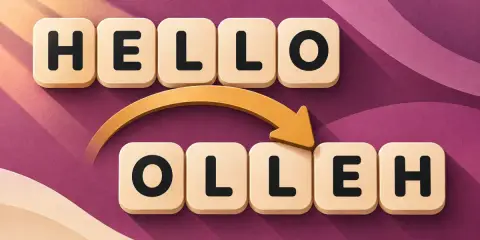
A palindrome reads the same forwards and backwards. Only the letters count: spaces, punctuation and capital letters are ignored, so “Step on no pets” works even though its spaces fall in different places. That is why the tool splits your text in two. Whatever letters you put in the front half must come back in reverse order in the back half, but you are free to cut them into different words.
In symbols: write the letters of the whole text as L₁ L₂ … Lₙ. It is a palindrome when Lᵢ = Lₙ₊₁₋ᵢ for every i, so the first letter equals the last, the second equals the second to last, and so on. The letter ladder shows exactly these pairs, column by column from the outer ends inwards. With an odd number of letters the one in the very middle pairs with itself; that is the Middle letter switch (the k of “saippuakauppias”).
Example: the front “Never od” has the letters n e v e r o d. Reversed they are d o r e v e n, which you can break into “d or even”. Joined, the text reads “Never odd or even.”: 14 letters in 7 matching pairs.
Each language keeps its own letters apart. In Finnish and Swedish ä is not a, and in Spanish ñ is not n; other accents count as the plain letter (é = e). Change this under Letter rules. The tool checks letters only, not whether the words make sense: that part is yours. Sources: Merriam-Webster, “palindrome”; the examples are traditional palindromes listed in each language's Wikipedia article on palindromes.
Sources
- Merriam-Webster: palindromeUsed for: definitions
- Unicode: UAX #29, Unicode Text SegmentationUsed for: rules
Frequently asked questions
Do spaces and punctuation have to match?
No. Only the letters are compared, so the words can break in different places on each side. Upper and lower case count as the same letter.
What is the longest one-word palindrome?
In everyday use it is often said to be the Finnish “saippuakivikauppias”, a soapstone seller, with 19 letters. In English, “racecar”, “level” and “rotator” are well known; most longer English ones are rare words.
What is the trick to writing a long palindrome?
Write a few words, look at the reversed letters on the back and find words hiding in them. Then add to the front so the back keeps making sense. Short words such as a, I, no and on are easy to fit on either side.
What is a word palindrome?
A sentence whose words, not letters, read the same in reverse, such as “Fall leaves after leaves fall”. Turn on Compare whole words in Check mode to test one.
Can I share my palindrome?
Yes. Copy the finished sentence from the result, or copy the link: it opens the tool with both halves filled in. Nothing is stored on a server.