What you enter stays on your device while you use this tool. Opening a shared link sends the settings in its address to HowToolbox to prepare the page.
Light takes
3.04 min
Mars (closest): 0.365 au away, so light takes 3.04 min.
- Distance
- 384,400 km
- There and back
- 2.56 s
- A car at 100 km/h
- 160 d
Light time from Earth to the Moon, the Sun, the planets, nearby stars or any distance, and what a car at 100 km/h would need.
How to use
- Choose where the light goes: the Moon, the Sun, a planet, a nearby star, or any distance of your own.
- For a planet, choose whether it is at its closest or farthest from Earth, because the distance changes through the years.
- Read how long the light takes, the round trip, and how long a car at 100 km/h would need for the same distance.
Light times from Earth
| Place | Light takes |
|---|---|
| Moon | 1.28 s |
| Sun | 8.32 min |
| Mars | 3.04 min |
| Jupiter | 32.7 min |
| Neptune | 3.99 h |
| Proxima Centauri | 4.25 yr |
| Sirius A | 8.61 yr |
| Polaris | 447 yr |
Planets at their closest; the time grows several times to their farthest distance.
How it works
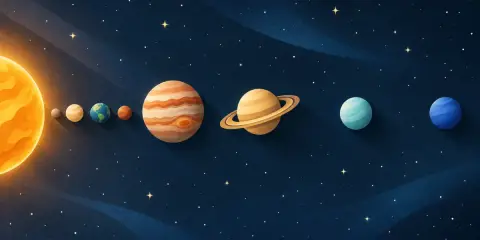
Light is the fastest thing there is, and still space is so large that it takes time to cross it. The light from the Moon is 1.3 seconds old when it reaches you, sunlight 8 minutes and 19 seconds, and the light of the nearest star other than the Sun more than four years. So when you look at the sky you see the past.
The time is t = d / c, where d is the distance and c = 299 792 458 m/s is the speed of light in a vacuum. The Moon, 384 400 km away on average, gives 384 400 / 299 792 = 1.28 s; the Sun, 149.6 million km (1 au), gives 499 s. A light-year is the distance light covers in a year, 9.46 trillion km, so a star 4.25 light-years away is 4.25 years of light time. For a planet the distance varies from its closest to its farthest approach, so the tool gives both ends.
The distances are averages or extremes from NASA's planetary fact sheet and from star catalogues, rounded; light is assumed to travel in a straight line through empty space. Messaging delays on a real spacecraft link also include equipment time. Sources: BIPM SI brochure, NASA Planetary Fact Sheet, SIMBAD and RECONS.
Sources
- BIPM: SI defining constantsUsed for: constants
- NASA Planetary Fact SheetUsed for: reference data
Frequently asked questions
Why does Mars have two answers?
Earth and Mars orbit at different speeds, so their distance varies from about 55 million km to about 400 million km. The light time ranges from 3 to 22 minutes.
What is a light-year?
The distance light travels in one Julian year, about 9.46 trillion km. It measures distance, not time, but equals a light time of one year.
Is the Sun I see the Sun of now?
You see it as it was 8 minutes and 19 seconds ago. If the Sun vanished, we would notice nothing for that long.
How long would it take to drive to the Moon?
At 100 km/h without stopping, 3844 hours, about 160 days. The tool shows this for any distance.
Does light really travel at a constant speed?
In a vacuum, yes: 299 792 458 m/s for every observer. In air, water or glass it is a little to a lot slower, but space is nearly empty.