How would your tune sound on a synth?
Play and shape a keyboard synth: choose the waveform, envelope, filter and LFO, then play with the mouse, touch, your computer keyboard or a MIDI keyboard.
What you enter stays on your device while you use this tool. Opening a shared link sends the settings in its address to HowToolbox to prepare the page.
Keyboard
Normal view. Keep-awake is off.
Computer keys: Z–M play the lower octave (S, D, G, H, J the black keys), Q–U the upper (2, 3, 5, 6, 7). Hold Space to sustain; − and + change the octave.
Synth sound
Oscillator
Envelope
Filter
LFO
Changing a setting switches the sound to Synth. Start with a preset, then turn one knob at a time.
MIDI keyboard
This browser does not support MIDI keyboards.
Note
C4
261.63 Hz · MIDI 60
Sound stays below a safe ceiling. Start with low volume on headphones.
Play and shape a keyboard synth: choose the waveform, envelope, filter and LFO, then play with the mouse, touch, your computer keyboard or a MIDI keyboard.
How to use
- Press the keys with the mouse or your fingers; several fingers play a chord, and sliding along the keys plays them one after another.
- On a computer keyboard, the bottom letter row plays the lower octave from Z (C) to M (B), with S, D, G, H and J as the black keys; Q to U play the octave above, with 2, 3, 5, 6 and 7.
- Pick a preset or shape the sound yourself in Synth sound: waveform, envelope, filter and LFO. Set the volume, change the octave with − and + or the buttons, and hold Space or turn on Sustain to keep notes ringing.
- To play from a MIDI keyboard, press Connect and allow access.
How it works
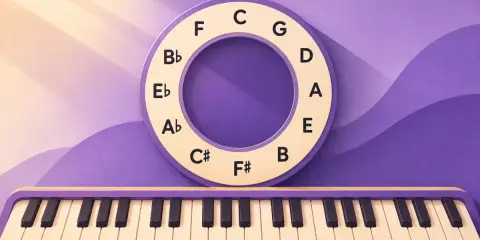
Each key is a note one semitone above the key to its left: twelve keys, seven white and five black, make an octave, where the frequency doubles. Notes are named by letter and octave number, and middle C is C4. In Finnish and German the note B is called H, and B flat is called B.
The pitch of every key follows equal temperament: f = 440 Hz × 2^((n − 69) / 12), where n is the key's MIDI number (A4 = 69, middle C = 60) and 440 Hz is the standard tuning note A4 (ISO 16). For example, middle C is 440 × 2^(−9/12) ≈ 261.63 Hz.
The Synth sound is built the classic subtractive way, in your browser. A raw wave (sine, triangle, sawtooth or square) is rich in overtones; the low-pass filter removes the ones above its cutoff, and resonance adds a peak there. The envelope shapes the volume of each note: attack is the rise, decay the fall to the sustain level held while the key is down, and release the fade after you let go. An LFO is a slow wave that wobbles pitch (vibrato), the filter (a sweep) or the volume (tremolo). The built-in instrument sounds are simple imitations, not recordings.
The computer keys follow the layout of music trackers such as ProTracker and FastTracker 2, which turned the letter rows into two piano octaves. Speakers, the browser and Bluetooth add a small delay; wired headphones are quickest.
Sources
- ISO 16:1975: Acoustics, standard tuning frequency (standard musical pitch)Used for: constants
- Wikipedia: ADSR envelopeUsed for: definitions
- Wikipedia: Scientific pitch notationUsed for: definitions
- Wikipedia: Subtractive synthesisUsed for: definitions
Frequently asked questions
How do I make a pluck, a pad or a bass?
Start from a preset. A pluck has no sustain and a quick filter sweep; a pad has a slow attack and release; a bass is a dark sawtooth with a low cutoff. Then move one slider at a time and listen to what it changes. Copy the page link to keep your sound.
Why is there a delay before the sound?
Every device needs a moment to turn a key press into sound. Wired headphones or speakers add the least; Bluetooth headphones can add a clearly noticeable delay.
Which MIDI keyboards work?
Most USB and Bluetooth MIDI keyboards work in browsers that support Web MIDI, such as Chrome and Edge. The keys, their strength and the sustain pedal are read on this device only.
Why does changing a sound setting not affect a held note?
The new settings apply to notes started after the change. Release the key and play it again to hear the new sound.
Can I add reverb or delay?
No. This synth has no reverb or delay effects. You can shape the sound with its oscillator, envelope, filter and LFO.