How long is a wave at a given frequency?
Convert between wavelength and frequency for light, radio and sound.
What you enter stays on your device while you use this tool. Opening a shared link sends the settings in its address to HowToolbox to prepare the page.
Wavelength
555.2 nm
Wave speed 299,792,458 m/s: a frequency of 540 THz is a wavelength of 555.2 nm.
Convert between wavelength and frequency for light, radio and sound.
How to use
- Choose whether to find the wavelength or the frequency, and the wave: light and radio, sound in air or water, or a speed of your own.
- Enter the frequency (or the wavelength) and its unit. For sound in air, set the air temperature.
- Read the answer in the most natural unit and copy the link to share it.
Wavelength of radio waves and light by frequency
How it works
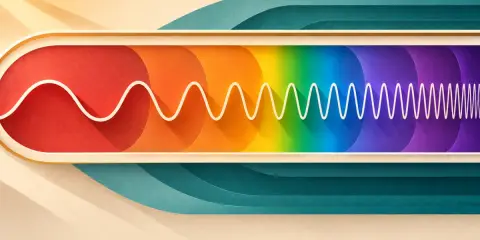
A wave repeats itself after a distance called the wavelength, and it does so a number of times per second called the frequency. Those two are tied together by how fast the wave travels: the faster the wave, the longer each repeat.
The relation is λ = v ÷ f, where λ is the wavelength in metres, v the speed of the wave in metres per second and f the frequency in hertz. Green light of 540 THz travels at the speed of light, 299 792 458 m/s, so its wavelength is 299 792 458 ÷ 5.4 × 10¹⁴ ≈ 555 nm. The same formula gives about 3 m for a 100 MHz FM radio signal and 0.78 m for a 440 Hz concert A in air at 20 °C.
Light and radio waves use the speed of light in vacuum, which is exact by definition; in air it is only about 0.03 % lower, and in glass or water clearly lower, so use your own speed for those. Sound in dry air goes at √(1.4 × 287.05 × T) metres per second, with T the temperature in kelvin as in the International Standard Atmosphere (ISO 2533): 331.3 m/s at 0 °C and 343.2 m/s at 20 °C. In fresh water at 20 °C sound travels about 1482 m/s (Greenspan and Tschiegg, NIST, 1957; NPL's guide to the speed of sound in pure water). Humidity, pressure and salinity change these numbers slightly.
Sources
- BIPM: The International System of Units (SI Brochure)Used for: constants
Frequently asked questions
What is the wavelength of visible light?
About 380 to 750 nm, from violet to red. Green light near 540 THz has a wavelength of about 555 nm.
How do I convert a radio frequency to a wavelength?
Divide the speed of light by the frequency: 300 million metres per second ÷ 100 million hertz gives about 3 metres for 100 MHz. Choose light and radio waves and enter the frequency.
Why does the wavelength of sound change with temperature?
Sound travels faster in warmer air, while the frequency of a note stays the same, so each wave is longer. The effect is about 0.6 m/s per degree Celsius.
Does the wavelength change when a wave enters another medium?
Yes. The frequency stays the same, but the speed changes, so the wavelength changes in proportion. Light slows down in glass, so its wavelength there is shorter.
What is the 21 cm line?
Neutral hydrogen in space emits radio waves of 21 cm. Enter 21 cm as the wavelength and choose to find the frequency to get about 1.43 GHz.
Can I use this to choose the physical length of an antenna?
It gives the wavelength, not a finished antenna design. Physical length also depends on antenna type, materials and end effects.
Next you might need





More in Physics
- Artificial gravity calculator, private, runs on your device
- Black hole time dilation, private, runs on your device
- Blackbody radiation calculator, private, runs on your device
- Buoyancy calculator, private, runs on your device
- Circular motion calculator, private, runs on your device
- Colour mixing: light and paint, private, runs on your device