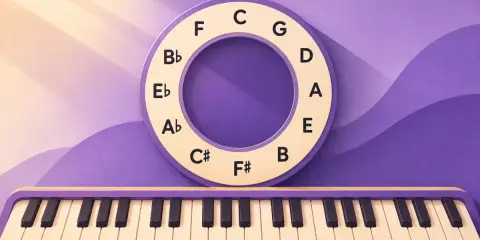
What are the notes called in other languages?
The twelve notes in English letters, the German and Nordic H and B, and do-re-mi, side by side.
What you enter stays on your device while you use this tool. Opening a shared link sends the settings in its address to HowToolbox to prepare the page.
Pitch
Reference pitch
The standard is 440 Hz; orchestras often tune a little higher.
Interval between two frequencies
The interval
- Cents
- +701.96
- Semitones
- +7.02
- Ratio
- 1.5
Frequency
440 Hz
A4, MIDI note 69
Octave and names
The twelve notes in English, German and solfège names
| English | German | Solfège |
|---|---|---|
| C | C | do |
| C♯ / D♭ | C♯ | do♯ |
| D | D | re |
| D♯ / E♭ | D♯ | re♯ |
| E | E | mi |
| F | F | fa |
| F♯ / G♭ | F♯ | fa♯ |
| G | G | sol |
| G♯ / A♭ | G♯ | sol♯ |
| A | A | la |
| A♯ / B♭ | B | la♯ |
| B | H | si |
The twelve notes in English letters, the German and Nordic H and B, and do-re-mi, side by side.
How to use
- Read across a row to see one of the twelve notes in each naming system.
- Find your note in the column you know, then read the name your sheet music, teacher or instrument uses.
- Switch to the note view to hear a note or get its frequency in hertz.
The twelve notes in each naming system
| English (sharps) | English (flats) | German / Nordic | Solfège (fixed do) |
|---|---|---|---|
| C | C | C | do |
| C♯ | D♭ | C♯ | do♯ |
| D | D | D | re |
| D♯ | E♭ | D♯ | re♯ |
| E | E | E | mi |
| F | F | F | fa |
| F♯ | G♭ | F♯ | fa♯ |
| G | G | G | sol |
| G♯ | A♭ | G♯ | sol♯ |
| A | A | A | la |
| A♯ | B♭ | B | la♯ |
| B | B | H | si |
The notes of one octave from C upwards. Notes with two spellings are the same key.
How it works
The same twelve notes have different names in different places. English-speaking countries use the letters A to G, with a sharp (♯) raising a note a semitone and a flat (♭) lowering it, so the black key between C and D is C♯ or D♭. The table gives both spellings, because the key is the same.
In Germany and much of northern and central Europe, including Finland and Sweden, the note a semitone below C is called H, and B means B flat. English calls them B and B♭. Mixing the two up is the most common mistake when a score or tab comes from another country.
Solfège gives each note a syllable instead: do, re, mi, fa, sol, la, si. The table uses fixed do, where do is always C, which is the practice in France, Italy, Spain and many other countries. In movable do, used in some teaching traditions, do is the first note of whatever key you are in.
Worked example
What is the note B called in a German score, and what does the German B mean?
- English B is H in the German system (and si in solfège).
- English B♭, the note a semitone lower, is B in the German system.
A German H is an English B, and a German B is an English B♭.
Sources
- ISO 16:1975: Acoustics, standard tuning frequency (standard musical pitch)Used for: formula, constants
- Wikipedia: Musical noteUsed for: definitions
- Wikipedia: SolfègeUsed for: definitions
Frequently asked questions
Is the note below C called B or H?
It depends on the country. In the German system the note below C is H and B means B flat; English and most other languages call them B and B flat.
Is C♯ the same as D♭?
On a piano and in equal temperament, yes: they are the same key and pitch. In written music the spelling depends on the key.
Does do always mean C?
In fixed do, yes. In movable do, do is the first note of the key, so it changes with the key.
What are the notes of the C major scale?
C, D, E, F, G, A, B (do, re, mi, fa, sol, la, si), the white keys from C to the next C. In the German system the last note is H.